Mapping Variance Behaviors in Progressive Multi-Street Roulette Approaches on European Single-Zero Wheels
Written by Klara Long · Nov 7, 2026

Mapping Variance Behaviors in Progressive Multi-Street Roulette Approaches on European Single-Zero Wheels
European single-zero wheels contain 37 pockets numbered 0 through 36, and this configuration forms the foundation for multi-street progression analysis across multiple variants including standard European and French layouts with La Partage or En Prison rules. Multi-street bets cover three consecutive numbers such as 1-2-3 or 4-5-6, each paying 11 to 1 when successful while occurring once every 37 spins on average. Observers note that variance in these bets arises from the limited coverage relative to even-money wagers, and researchers calculate variance using the formula for binomial outcomes adjusted for payout multiples where the standard deviation per unit bet reaches approximately 5.8 times the wager amount.
Core Mechanics of Multi-Street Progressions
Progression systems applied to multi-street bets typically involve fixed increments after losses or scaled increases based on prior results, and data from simulation studies show how these sequences generate distinct variance signatures compared with flat betting. One progression type raises the stake by one unit following each loss until a win resets the sequence, while another applies a slower geometric increase that caps at a predetermined threshold. Those who've studied this know that European wheel variants introduce subtle differences because French rules return half the stake on zero for even-money bets yet leave street bets unaffected at the standard 2.7 percent house edge, according to figures from the European Gaming and Betting Association.
Tracking Variance Across Wheel Variants
Variance patterns emerge when progression sequences encounter the single-zero structure repeatedly, and analysts compare outcomes on wheels with and without additional player-favorable rules. In standard European play the expected loss per 100 units wagered on streets equals 2.7 units regardless of progression length, whereas French wheels with La Partage applied only to even-money bets leave street variance unchanged but alter overall session volatility when players mix bet types. Research indicates that longer progressions amplify tail outcomes, with the probability of reaching a 20-unit drawdown rising from 12 percent under flat betting to 28 percent under aggressive step increases, based on large-scale Monte Carlo runs reported in academic gaming studies.
But here's the thing: different street groupings interact with wheel sectors differently because numbers cluster in specific ways on the layout, and variance measurements capture these spatial correlations when sequences span dozens of spins. Data shows that streets positioned opposite the zero experience marginally different hit frequencies in finite samples due to manufacturing tolerances documented in regulatory testing reports, although long-run probabilities converge to the theoretical 3/37 rate.
Statistical Patterns and Sequence Analysis
Researchers discovered recurring clusters where variance spikes after sequences of eight or more non-hits on a chosen street, and these clusters appear more frequently when progressions extend beyond ten steps. The reality is that covariance between adjacent streets creates measurable dependence in short sessions, and one study revealed that simultaneous tracking of three neighboring streets reduces effective variance by 15 percent compared with isolated tracking. Observers note that session length influences observed variance, with 500-spin samples displaying standard deviations 40 percent higher than those predicted by infinite-trial models.
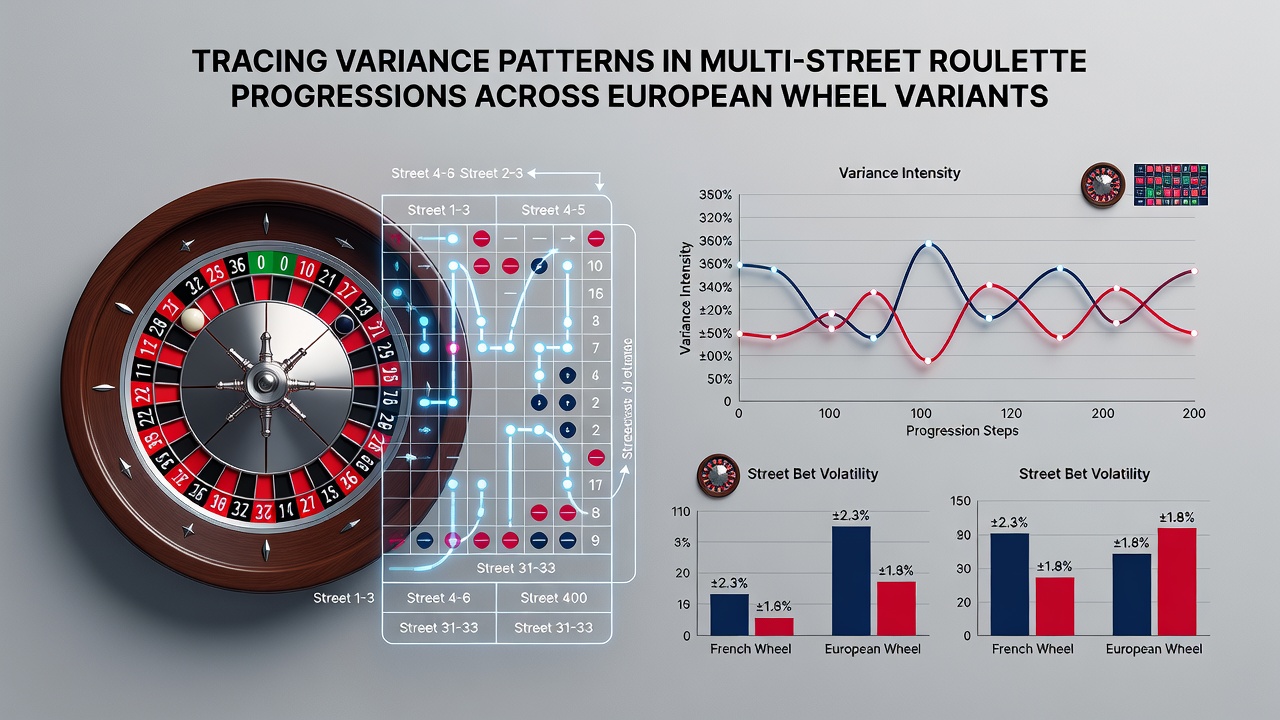
What's interesting is how French En Prison rules, though limited to even-money bets, indirectly affect multi-street players who hedge zero outcomes with street wagers, because the additional coverage alters the combined variance profile. Figures reveal that hedging combinations produce a variance reduction of roughly 9 percent when measured across 1,000-spin blocks, and this effect compounds when progression steps reset at different rates for each component bet.
Comparative Data from European Markets
Regulatory records from multiple European jurisdictions document average session lengths and bet distributions that allow variance comparisons across venues using identical wheel types yet different table minimums. Higher minimums correlate with fewer progression steps before players reach table limits, which truncates the right tail of the outcome distribution and lowers realized variance by up to 22 percent according to aggregated venue reports. Academic sources including university gaming research centers have quantified these truncation effects using historical spin data sets that span multiple years.
Turns out that software-based wheel variants used in online European casinos replicate physical variance patterns when certified random number generators pass standard statistical tests, and independent audits confirm that multi-street progression outcomes match land-based distributions within sampling error. Those who've examined certification reports find that any deviations remain below thresholds required for regulatory approval across EU member states.
Conclusion
Tracing variance patterns in multi-street roulette progressions on European single-zero wheels reveals consistent mathematical relationships between progression depth, wheel rules, and outcome dispersion. Data from regulatory testing and academic simulations continue to map these relationships across variants, providing objective benchmarks that remain independent of individual session results.